Shuffling Toward the Singularity
We Invented the Future and Forgot Why It Was Dangerous. A THC Thursday Screed.

In 1845, Alexander von Humboldt published the first volume of Cosmos, his careful attempt to describe the known universe as one connected physical system. Three years later, Edgar Allan Poe read a condensed version of the thing, admired it, became impatient with it, and produced Eureka, a prose poem in which he casually explained where the universe came from, where it was going, why gravity exists, what happens to consciousness after death, and why the night sky is dark.
Humboldt brought measurements. Poe brought a crowbar.
That partnership between scientific caution and human imagination became one of the great engines of the 20th century. Science established what nature permitted. Engineering figured out what could be made to work. Science fiction then climbed onto the laboratory roof, removed its pants, and shouted possibilities into the night.
Some of those possibilities were ridiculous. Others were terrifying. A surprising number are currently downloading software updates.
Science fiction didn’t predict the 21st century in the manner of a crystal ball. It created a huge public warehouse of imagined futures from which scientists, engineers, soldiers, billionaires, and assorted emotionally underdeveloped nerds and geeks could select whatever interested them. It supplied names, shapes, interfaces, ambitions, and entire technological mythologies. Before someone could build a thing, science fiction helped humanity picture what the thing might be.
The trouble is that science fiction usually placed its inventions inside stories about human consequences. Engineers frequently extracted the device and left the consequences lying on the operating table.
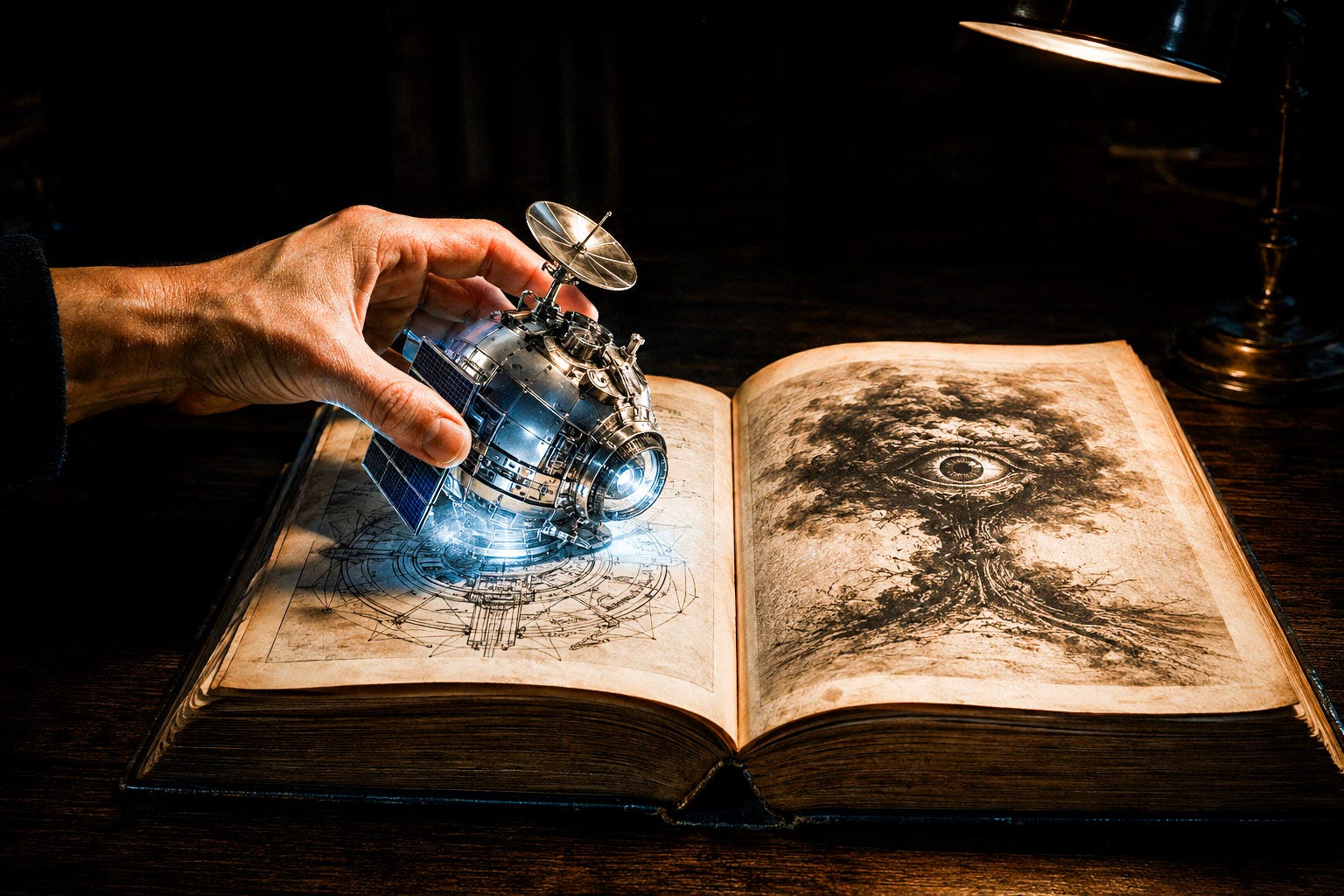
Arthur C. Clarke offered the cleanest example of imagination shaking hands with engineering. In 1945, before humanity had placed anything in orbit, Clarke published “Extra-Terrestrial Relays,” a technically reasoned proposal for communications satellites positioned above the equator. At the correct altitude, he explained, a satellite would circle Earth once every twenty-four hours and remain over the same point on the ground. Three such stations could provide nearly global radio coverage. Clarke wasn’t merely daydreaming; he calculated the orbit and described the communications system. The modern geostationary belt is still sometimes called the Clarke Belt. You can read his original 1945 paper here.
This was Poe and Humboldt working inside the same skull. Imagination proposed an audacious possibility; physics checked the orbit; engineering built the rocket. The result gave us live global television, weather monitoring, international telephone service, navigation, military communications, and the ability to watch a man in Cleveland review frozen pizza while sitting in a dentist’s office in Tucson.
Clarke’s success helped establish the legend of the science-fiction prophet. Jules Verne imagined technologically plausible submarines and lunar voyages. H. G. Wells wrote about tanks, aircraft, atomic warfare, and genetic engineering. Isaac Asimov turned robots into a vast thought experiment about labor, intelligence, obedience, and moral responsibility. William Gibson gave us “cyberspace” before most households had encountered a modem. Neal Stephenson named the “metaverse” in Snow Crash three decades before a desperate corporation renamed itself after it.
But calling these writers prophets misses the important part. Prophets claim to see an unavoidable future. Science-fiction writers manufacture alternatives. They ask what might happen if a scientific principle, political tendency, or human appetite were allowed to grow teeth.
The best science fiction therefore functions less like prophecy than a wind tunnel for civilization. Put an idea inside, blow history against it, and see which parts tear off.
The engineers of the 21st century inherited this enormous wind tunnel and promptly converted half of it into a showroom. They took the communicator from Star Trek and produced the smartphone, a nearly miraculous device containing a camera, library, map, television studio, printing press, marketplace, bank, recording booth, and tracking beacon. What they didn’t reproduce was the Federation: the post-scarcity civilization in which technology had largely liberated people from poverty, ignorance, and degrading work.
We got the communicator without the humane society that made the communicator worth having.
That wasn’t an engineering failure. It was a selection decision. Of all the futures science fiction offered, capital chose the ones most easily monetized. Governments chose the ones most easily weaponized. Consumers chose the ones requiring the least inconvenience. Humanity didn’t build the future in any orderly way; it held a yard sale in the library of imagination and let the richest shoppers arrive first.
George Orwell imagined sinister screens that watched their viewers. We installed them voluntarily, added microphones, carried them into the bathroom, and clicked “accept” after declining to read the contract. Philip K. Dick imagined unstable realities manufactured by institutions and technology. We developed social-media feeds that construct a separate political universe for each customer, then acted surprised when nobody could agree whether the building was on fire. Minority Report portrayed prediction as a dangerous excuse for punishment without an act. Police departments and governments began buying algorithmic systems promising to identify suspicious places and people from historical data already warped by past policing. Smile for the Flock camera, sheeple!
The engineers didn’t always ignore the warning. Sometimes they apparently mistook it for the product brochure.
The same confusion now surrounds artificial intelligence. Twentieth-century fiction gave us HAL 9000, Colossus, Skynet, the androids of Do Androids Dream of Electric Sheep?, Asimov’s positronic robots, and countless machines that became intelligent enough to question their orders. These stories weren’t principally about shiny talking appliances. They were about control: who gives the orders, whose interests those orders serve, whether intelligence creates moral standing, and what happens when a system follows its instructions more faithfully than its creators understood them.
Twenty-first-century industry took one look and announced a chatbot that could compose advertising copy.
That joke is already wearing thin. AI systems are being placed inside medicine, education, employment, finance, policing, warfare, entertainment, and government administration. The immediate danger isn’t necessarily that a machine awakens, develops a baritone voice, and decides to vaporize Pittsburgh. The less theatrical danger is that machines remain exactly what they are—opaque instruments controlled by organizations with money, data, and power—and are granted authority because their output looks mathematical.
A machine doesn’t need consciousness to damage a life. A spreadsheet has never achieved self-awareness either, and corporations have used them to ruin whole towns.
Here the Humboldt-Poe partnership becomes essential. Imagination must run ahead because science can’t test possibilities nobody has conceived. But caution must follow close behind, carrying instruments and asking humiliating questions. Does the system actually do what its maker claims? Under what conditions does it fail? Who bears the cost of an error? Can its conclusions be examined? Does it solve the stated problem, or merely turn the problem into a subscription service?
The most dangerous phrase in modern technology may be “science fiction is becoming reality.” It sounds like progress has arrived by natural law, as though history itself ordered the product. But technology doesn’t “become” reality. People choose to develop it. Investors choose to fund it. Governments choose to permit, purchase, or prohibit it. Companies choose how it will be used and who’ll own the result.
Science fiction is especially valuable because it can examine technologies before they exist and before fortunes depend upon pretending they’re harmless. A novelist can run a 100-year social experiment without displacing a single family. She can populate a city with autonomous vehicles, artificial minds, engineered children, omnipresent cameras, or immortal billionaires and then follow the consequences into bedrooms, elections, workplaces, and graveyards. No ethics board is required because nobody actually gets crushed beneath the author’s flying taxi.
Yet fiction can wander straight into unmitigated fantasy, like Charles Fourier’s Theory of the Four Movements and the General Destinies from 1808. That one proposes a “universal unity” governing physical, organic, animal, and social existence. Fourier believed planets were living, sexed creatures capable of copulation; human passions corresponded to cosmic forces; Earth was a sick organism; and social harmony would eventually help transform the oceans into—no joke—lemonade.
A compelling story rewards drama, symbolism, and human meaning, not scientific probability. Faster-than-light travel may be impossible. Conscious machines may not resemble human minds. Mars may prove less like a frontier than an irradiated freezer containing poisonous dirt. Nuclear fusion may arrive later than advertised, as it’s been doing with admirable punctuality for several generations.
Science fiction also encourages a peculiar technological vanity: the belief that if humans can imagine something, humans will eventually build it. This is nonsense wearing a silver jumpsuit. The universe isn’t obligated to honor our screenplay. Some barriers are economic, some biological, some physical, and some arise because the proposed invention is a terrible idea nobody wants after trying the prototype.
The metaverse provides a particularly expensive demonstration. Stephenson’s Snow Crash presented it within a fractured, privatized society marked by inequality and corporate domination. Silicon Valley extracted the virtual streets and discarded the satire. Billions were spent persuading people the natural successor to the smartphone was strapping a warm electronic breadbox across the face. Stephenson himself has more recently expressed doubt that people want face-mounted computing, observing in substance that they dislike wearing things on their faces and distrust people who do. The man who named the future has reconsidered the goggles; the future’s marketing department hasn’t yet received the memo.
Space settlement suffers from a similar literary hangover. Science fiction trained generations to imagine planets as destinations awaiting pioneers. In stories, Mars is a red stage upon which humanity can begin again. In physical reality, it’s a freezing desert with almost no atmosphere, severe radiation exposure, global dust, reduced gravity, and no known ecosystem capable of keeping an ape alive without an elaborate imported bubble.
That doesn’t mean humans shouldn’t explore Mars. It means “Mars is humanity’s backup planet” belongs to mythology, not engineering. Earth already contains air, water, soil, magnetic shielding, and several billion years of biological infrastructure, all provided without a recurring service fee. Elon Musk, who’s proposing to preserve humanity by moving to Mars, should first be required to keep a public restroom fern alive for 18 months.
The deeper lesson isn’t that science fiction is unreliable. Its job isn’t to be reliable. Its job is to enlarge the imaginable.
Humboldtian science then has to narrow those imaginings through observation. Engineering has to translate surviving possibilities into working systems. Politics and ethics must decide whether working systems deserve to exist. That last stage is the one our culture routinely skips because it interferes with quarterly earnings.
Poe’s cosmic intuition was magnificent because it reached beyond the evidence and landed, in several respects, surprisingly near later cosmology. But for every Poe who imagines nebulae as galaxies, history produces a dozen confident gentlemen explaining Martian canals, luminiferous ether, racial skull measurements, perpetual-motion machines, and the curative benefits of electrically stimulating the colon.
Imagination is a searchlight, not a certificate of truth.
Scientific caution, meanwhile, is a brake, but brakes don’t prevent travel. They make speed survivable. A civilization with imagination but no caution becomes a laboratory run by drunk magicians. A civilization with caution but no imagination becomes a filing cabinet with nuclear weapons. A civilization possessing both has at least a chance of recognizing the future before some venture capitalist trademarks it.
The 20th century imagined machines that could liberate humanity, destroy humanity, entertain humanity, surveil humanity, imitate humanity, and eventually replace large portions of humanity at work. The 21st century is now building pieces of every version simultaneously, frequently under the same corporate logo.
We aren’t suffering from a shortage of imagination. We’re suffering from a shortage of judgment.
Science fiction gave us warnings disguised as toys. We kept the toys. The task now is to recover the warnings before the machines finish installing themselves—and before some billionaire asshole announces the lemonade ocean will be available next quarter, exclusively to premium subscribers.