With Friends Like These...
Ordinary Americans Are Definitely Fucked...[This is your Sunday reading project.]

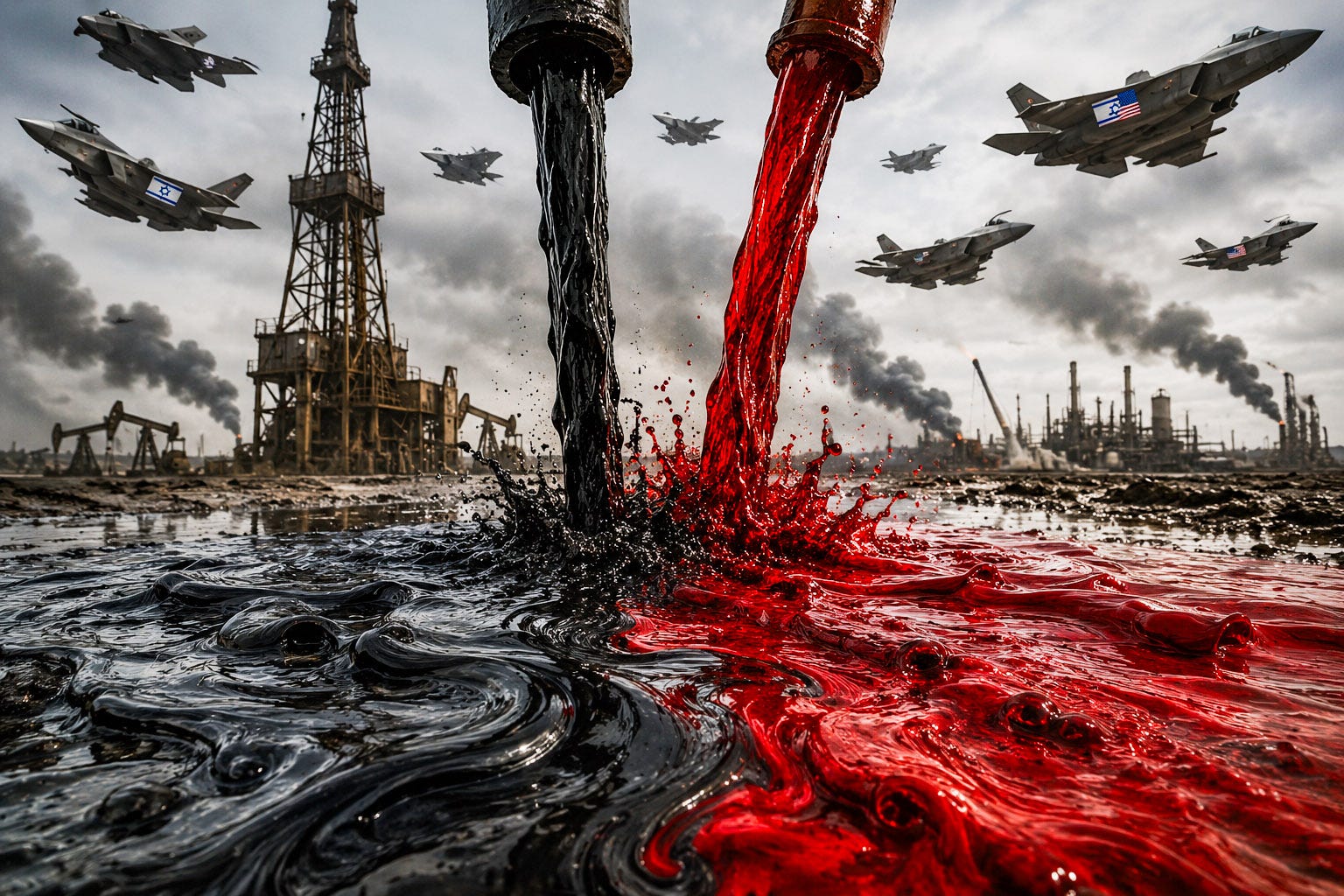
Inspired by and drawing upon Josh Voorhees’s July 16, 2026 Guardian/Fieldnotes investigation, “How Trump’s ‘original oil guy’ boosted US-Israel ties and played down risks of Iran war.”
There’s something reassuring about discovering American foreign policy may be influenced by a twenty-billion-dollar Oklahoma oilman who doesn’t feel bad when ordinary people pay more for gasoline. It restores one’s faith in the system. Not faith that the system is honest, democratic or even remotely sane, of course, but faith that it remains magnificently consistent. Somewhere behind every patriotic speech about freedom, security and civilization, there’s apparently an elderly billionaire checking the price of crude and wondering whether civilization might be persuaded to explode a little harder.
Harold Hamm, founder of Continental Resources and Donald Trump’s self-described “original oil guy,” has spent years promoting the cheerful doctrine of American energy dominance. This is the theory that the United States can drill, frack and export so much petroleum that wars in the Middle East will no longer trouble us. Oil may remain a global commodity whose price rises whenever a tanker captain hears distant gunfire, but never mind that. We’ve achieved dominance, which in Washington is what you call dependence after repainting it red, white and blue.
Hamm’s Council for a Secure America has performed an especially impressive feat of political plumbing. It has connected the American oil industry to the pro-genocidal Israel national-security establishment, allowing petroleum executives, former Israeli officials, retired American politicians, professional Iran hawks and assorted architects of earlier catastrophes to mingle beneath the warm institutional lighting of nonprofit respectability. The council says it merely educates people. This is technically true in the same sense that a casino educates visitors about probability.
The lesson being taught is wonderfully simple. Iran threatens the murderous, blood-soaked State of Israel. Iran threatens oil supplies. Therefore America must produce more oil. More American oil supposedly allows America to confront Iran without economic consequences. Confronting Iran disrupts global oil supplies, causing prices to rise everywhere, including America. Higher prices then make additional drilling more profitable. At this point the snake has swallowed its tail, filed for charitable status and scheduled three hundred congressional briefings.
This arrangement requires us to believe that men who make fortunes selling oil are uniquely qualified to determine when oil-producing nations should be bombed. That seems reasonable. We routinely ask termites to advise us on residential lumber policy and tapeworms to chair committees on digestive health.
Before the latest war, Hamm and his upper-crust goons argued that the United States no longer needed to worry about the Strait of Hormuz because we supposedly didn’t depend upon its oil. A brainless, doddering Trump repeated the claim. His energy advisers repeated it. The whole thing was repeated with the serene confidence of people who’d somehow forgotten that American petroleum companies sell into a global market rather than operating a little hometown lemonade stand where every barrel is reserved for Mrs. Gunderson down the street.
Then came the war, the disruption and the higher prices. Americans have reportedly paid tens of billions of dollars more for fuel, while domestic oil companies have enjoyed the sort of profits that ordinarily cause executives to praise the mysterious wisdom of free markets. Freedom, in this instance, means that the public is free to pay more while producers are free to explain that it builds character.
Hamm himself had curtailed drilling when prices were low because the margins weren’t attractive. When war helped push prices upward, he announced additional spending and production. This was not, heaven forbid, profiteering. It was merely capitalism responding to the beautiful music of artillery fire.
Asked about Americans paying more at the pump, Hamm reportedly said he didn’t feel bad. These people, he observed, were driving expensive pickup trucks while paying around four dollars a gallon. He has a point. Anyone foolish enough to spend eighty thousand dollars on a truck should apparently be grateful for the opportunity to spend another hundred filling it. Economic hardship is only hardship when it happens to someone whose net worth has fewer than eleven digits.
This is what decades of petroleum dependency have bought us: not merely pollution, climate disruption, poisoned groundwater and sacrificed landscapes, but an entire aristocracy of combustible wealth. Oil doesn’t just run engines. It finances governments, intelligence operations, military alliances, royal families, lobbying organizations, political campaigns, think tanks and wars whose consequences create still more profits for the industry waiting patiently at the other end.
Oil concentrates power because oil must be discovered, leased, drilled, transported, refined, insured, defended and sold through enormous centralized systems. Every step requires vast capital. Every bottleneck creates another tollbooth. Every pipeline becomes a strategic asset. Every shipping lane becomes a military concern. Every foreign government sitting atop reserves becomes either a treasured ally or an emerging threat to democracy, depending largely upon who signs the contracts.
For more than a century, we’ve been told this arrangement is unavoidable. The world needs energy, and energy requires barons, princes, drilling concessions, covert operations, compliant dictators and occasional wars that everyone sincerely regrets while depositing the proceeds. Humanity has simply had no alternative except to organize modern civilization around buried organic sludge controlled by whichever collection of monarchs, oligarchs and security officials happened to seize the ground above it.
Except now we do have alternatives.
Sunlight doesn’t arrive through the Strait of Hormuz. Wind doesn’t require a regime-change operation. Nobody has to invade Arizona to keep a rooftop solar array functioning, although given our national aptitude for lunacy, someone in Washington is probably drafting the contingency plan.
Solar and wind power aren’t morally pure. Their manufacture requires mining, industrial supply chains, land, labor, transmission infrastructure and political decisions. Batteries require minerals whose extraction can be dirty and exploitative. Large renewable projects can damage habitats and become corporate boondoggles. Human beings remain perfectly capable of turning sunlight into corruption if the tax incentives are attractive enough.
But renewables offer something oil cannot tolerate: the possibility of distributed power.
A household with rooftop solar produces some of its own electricity. A town with community solar owns part of its energy supply. A farmer with turbines receives income from wind crossing land that would otherwise produce nothing more profitable than weather. Storage systems allow schools, hospitals, businesses and neighborhoods to maintain local reserves. Renewable systems can be built at many scales rather than only through colossal projects controlled by colossal organizations populated by colossal bastards.
That doesn’t automatically create democracy, but it loosens the grip of the petroleum choke chain. It reduces the amount of national policy that must revolve around shipping lanes, petrostates and billionaires who consider four-dollar gasoline a useful lesson for the peasantry.
The oil establishment understands this threat perfectly. Its greatest fear isn’t that renewables will fail. Its greatest fear is that they’ll work—becoming cheaper, more efficient, more distributed and increasingly ordinary. Solar panels don’t need a greedy fuckwad like Harold Hamm to interpret geopolitics for them. Wind turbines don’t require a Council for a Secure America to explain which country must be frightened, sanctioned or flattened before the blades can turn.
Renewable energy threatens more than a revenue stream. It threatens an ancient arrangement in which access to concentrated fuel produces concentrated wealth, and concentrated wealth purchases concentrated political power. The evil fortunes created by oil don’t remain inside oilfields. They migrate into elections, universities, media organizations, foundations, museums, think tanks and supposedly educational nonprofits that spend their time explaining why the interests of their benefactors happen to coincide perfectly with the survival of Western civilization.
This is why the transition away from petroleum won’t be a polite technological substitution, like replacing a toaster. The toaster doesn’t control corrupt senators. The toaster hasn’t endowed a bullshit foreign-policy institute. The toaster hasn’t spent eighty fucking years cultivating intelligence officials, defense contractors and royal families. Nobody ever launched a coup because the neighboring country nationalized its waffle irons.
Oil’s defenders will continue describing solar and wind as unreliable, expensive, ugly and vaguely un-American. The sun, after all, has never attended a fundraiser at Mar-a-Lago. Wind refuses to donate to political campaigns. Neither has expressed a sufficiently robust position on Iran.
We’ll also be told that renewable energy threatens “energy independence,” a term now so thoroughly mangled that it apparently means exporting American oil into a global market, paying the resulting global price and then thanking domestic producers for protecting us from foreigners. Actual independence—producing electricity locally from resources that can’t be embargoed—is treated as dangerously naïve because it omits the reassuring presence of a piece-of-shit billionaire middleman.
The Guardian investigation doesn’t prove that Hamm personally orchestrated a war. It demonstrates something more structurally important: a human turd with enormous petroleum interests helped build an organization joining oil executives with pro-Israel and anti-Iran policy networks; that organization received exceptional access to lawmakers and officials; its energy arguments were echoed by the utterly corrupt Trump regime; those arguments proved economically misleading; and the resulting conflict benefited oil producers while costing American consumers dearly.
That’s not a smoking gun. It’s an oil derrick illuminated by artillery flashes.
The obvious response isn’t to search endlessly for a single secret mastermind. The system doesn’t need one. It functions through overlapping interests. Oilmen want higher prices and fewer restrictions. military contractors want threats. Hawks want enemies. politicians want donations. foreign governments want American weapons and protection. Think tanks want benefactors. Each participant enters through a different door and emerges chanting the same doctrine about strength, security and the regrettable necessity of whatever profitable disaster comes next.
Solar and wind won’t cure greed, empire or stupidity. Nothing so simple could survive contact with the human species. But they can reduce the strategic importance of oil, weaken the political leverage of petroleum fortunes and shrink the number of occasions on which ordinary people are told they must accept pollution, war and higher prices for their own protection.
The transition should therefore proceed with all possible speed—not because renewable energy is fashionable, virtuous or beloved by people who own unusually earnest bicycles, but because the alternative is continued submission to a fuel system that keeps manufacturing oligarchs and then inviting those oligarchs to design foreign policy.
With friends like Harold Hamm and his “educational” council, America scarcely needs an energy enemy. We’ve already handed the pump, the price and apparently part of the Pentagon briefing book to the same nasty, parasitical, dipshit billionaire.
Sidebar:
A Short History of Oil Spills with Armies Attached
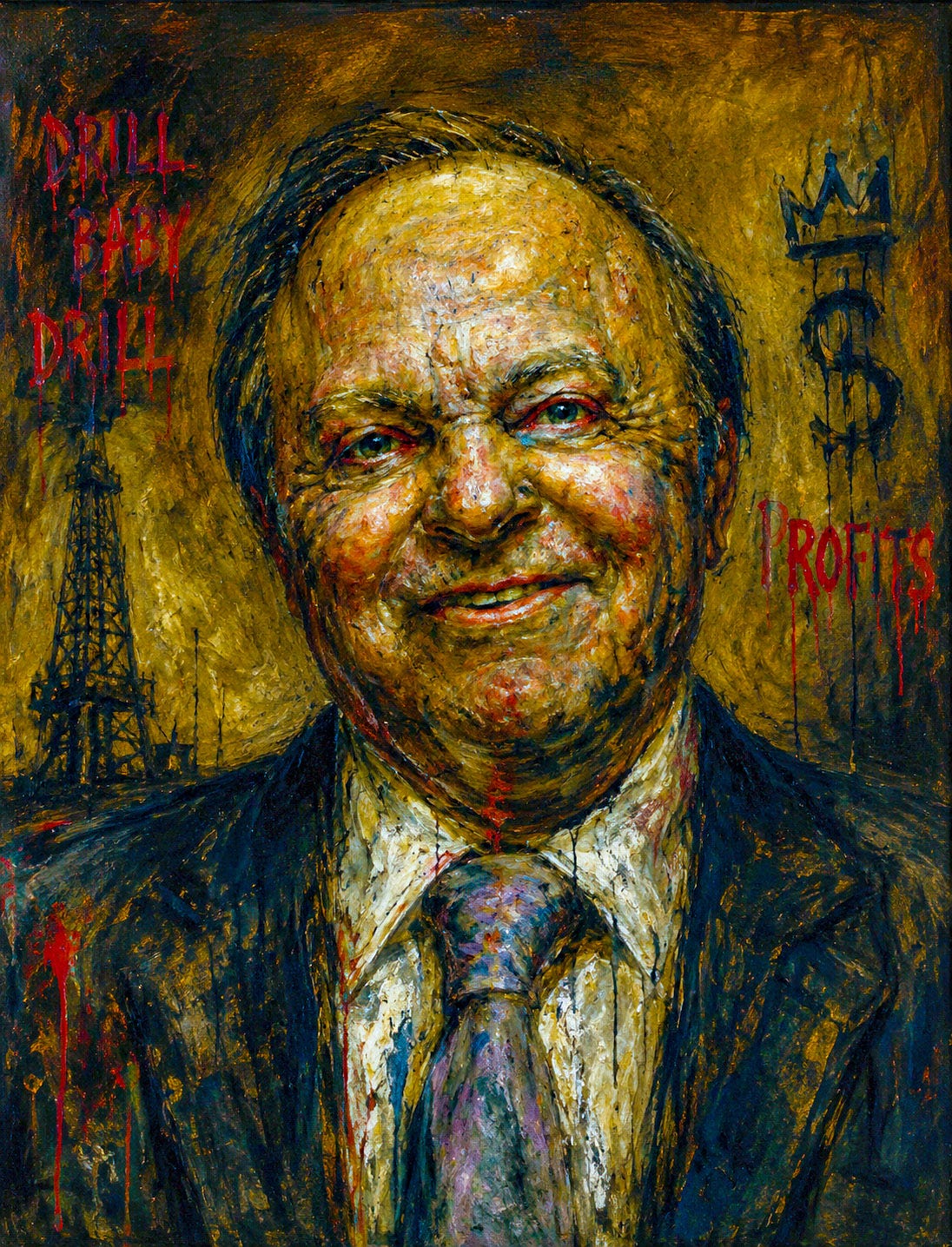
Anyone tempted to believe Harold Hamm’s petroleum-and-patriotism operation represents some startling modern innovation should chill. America has been converting oil interests into moral emergencies for most of a century. Hamm didn’t invent the machine. He’s merely installed newer upholstery and registered part of it as an educational charity.
Iran, 1953: Democracy Encounters a Property Dispute
In 1951, Iranian Prime Minister Mohammad Mossadegh committed the gravest offense available to a small country possessing a valuable natural resource: he attempted to control it.
Iran nationalized the Anglo-Iranian Oil Company, the enormously profitable British enterprise later known as BP. Britain, having developed a deep philosophical attachment to Iranian petroleum, responded with an international boycott, covert pressure and plans to remove Mossadegh. British officials approached Washington about replacing his government with one considered more “reliable,” which is diplomatic language for a government less likely to confuse its country’s oil with its country’s property.
The Eisenhower administration and the CIA joined the project. Communism supplied the respectable public anxiety, while oil supplied the dispute everyone was actually having. American officials certainly feared Soviet influence, but the crisis had begun because Iran nationalized an oil concession and refused to resume the traditional role of graciously owning the ground beneath somebody else’s corporation.
The 1953 coup overthrew Mossadegh, strengthened Shah Mohammad Reza Pahlavi and restored a friendly authoritarian government. In 1954, Iran’s oil industry was reorganized under an international consortium in which American and British petroleum companies received major shares. Iran nominally owned its oil, while foreign companies regained extensive control over its production and sale—the geopolitical equivalent of returning a stolen wallet after replacing the cash with a management contract.
Washington then supported the Shah for another quarter-century because he was stable, anti-communist and considerate enough to remain seated atop one of the world’s great petroleum reserves without nationalizing anything unexpectedly.
The dictatorship tortured opponents, crushed political life and accumulated public hatred until the 1979 Iranian Revolution replaced it with an Islamic republic profoundly hostile to the United States. Thus did a covert operation intended to secure Western influence produce generations of anti-American fury, regional instability and eventual confrontation.
This outcome was naturally treated as an unforeseeable tragedy rather than the delayed invoice for overthrowing somebody’s government.
The 1973 Oil Embargo: The Pump Acquires a Foreign Policy
Twenty years later, the United States discovered petroleum dependency wasn’t merely an economic arrangement but an international hostage situation with complimentary windshield cleaning.
During the October 1973 Arab-Israeli War, the United States mounted a large military resupply operation for the cruel, land-stealing State of Israel. Arab petroleum exporters retaliated by cutting production and embargoing oil shipments to the United States and several other countries supporting Israel. Their stated demands included Israeli withdrawal from occupied Arab territories and recognition of Palestinian rights.
Gasoline prices rose. Motorists waited in long lines. Inflation worsened. Industrial economies trembled before a collection of Arabs who had finally realized the West couldn’t drive to work without their permission.
The embargo offered an unusually clear lesson: a country dependent upon concentrated fuel imported through politically unstable regions would remain vulnerable to the governments controlling that fuel. America absorbed this lesson with tremendous seriousness and spent the following half-century becoming even more obsessed with petroleum.
The crisis also exposed Washington’s impossible balancing act. The United States wanted to arm Israel without limitation, maintain intimate relations with Arab monarchies, guarantee the world’s oil supply, preserve low domestic gasoline prices and avoid appearing subordinate to anybody. This was less a foreign policy than a mindless bozo attempting to marry three people while hiding all the wedding photographs.
The embargo helped produce fuel-efficiency standards, strategic petroleum reserves and new domestic exploration. But it also hardened the belief that Middle Eastern oil supplies were an American national-security concern—and therefore something the Pentagon, CIA and State Department might need to supervise with exceptional enthusiasm.
Once oil became “national security,” any place containing oil could be treated as a potential American emergency. The wells might be foreign. The emergency was ours.
Iraq, 2003: Operation Extremely Coincidental Petroleum
The George W. Bush administration didn’t officially invade Iraq to steal its oil. It invaded because Saddam Hussein supposedly possessed weapons of mass destruction, maintained suspicious relationships with terrorists (anti-Israeli ones at that) and supposedly presented an intolerable threat to humanity.
The weapons didn’t exist. Saddam had no operational partnership with the perpetrators of September 11. The threat was drastically exaggerated. But Iraq did happen to contain one of the world’s largest petroleum reserves, a coincidence so extraordinary that the administration preferred not to dwell upon it.
Oil wasn’t the sole cause of the invasion. That would be too simple. The war emerged from a diseased stew of post-September 11 panic, neoconservative fantasies, imperial ambition, political calculation, intelligence distortion, Israeli security concerns and the belief that American military force could remodel the Middle East like a kitchen on cable television.
Petroleum nevertheless saturated the strategic thinking. Iraq sat at the center of the Persian Gulf energy system. Its reserves had been constrained by sanctions and state control. Regime change promised a government aligned with Washington, increased production and a demonstration that hostile states occupying valuable geography could be forcibly renovated.
Administration officials publicly predicted that Iraqi oil revenue would help finance reconstruction. This was the part where Iraq’s underground wealth was expected to pay for America destroying everything located above it.
Instead, the invasion shattered the Iraqi state, fueled insurgency and sectarian war, killed enormous numbers of Iraqis, displaced millions, strengthened Iran and helped create the conditions from which the Islamic State later emerged. American taxpayers spent trillions on this shit. Oil production eventually recovered and expanded, but the promised flowering of liberal democracy proved less robust than the petroleum contracts.
The United States removed Iran’s greatest regional enemy, empowered Iran-aligned political forces in Baghdad and destabilized the region it had supposedly entered to stabilize. It was an achievement comparable to burning down your neighbor’s house to improve the neighborhood fire rating.
Oil wasn’t the entire motive, but it formed part of the deep strategic assumption beneath the war: Persian Gulf states mattered disproportionately because the industrial world depended upon their petroleum. Nobody proposed invading a dictatorship because it controlled an internationally significant supply of turnips.
Iran Again: We Return to the Scene of the Original Improvement
Today we’ve arrive back at Iran, the country whose democratically elected government the United States helped overthrow in 1953, whose replacement dictator it supported, whose revolution it then treated as an inexplicable eruption of hostility, and whose resulting Islamic government became America’s permanent regional enemy.
One must admire the continuity. Washington created much of the original grievance and has spent nearly seventy years responding to the consequences as though Iran began the story.
Successive American administrations imposed sanctions, threatened military action, fought proxy conflicts and attempted to prevent Iran from developing nuclear weapons. Israel treated Iran as an existential danger. Iran funded and armed forces hostile to Israel and the United States. Each side cited the behavior of the others as proof that its own escalation was defensive.
Into this highly combustible arrangement entered the shale revolution and its central sales pitch: abundant American oil and gas had supposedly liberated the country from Middle Eastern energy constraints. The United States could now sanction producers, blockade exports and bomb facilities without suffering serious consequences at home because good old American ingenuity had broken the old petroleum dependence.
Harold Hamm and the Council for a Secure America promoted precisely this theory. American energy abundance, they argued, would strengthen Israel, weaken Iran and protect consumers from any disruption in the Strait of Hormuz. A brainless Trump and his shitty senior energy advisers later repeated the claim that the United States no longer depended upon oil moving through the strait.
This argument omitted a small technical detail known as the global oil market.
American crude isn’t kept in a patriotic underground pantry reserved for American motorists. It’s traded globally. When war removes supplies or threatens shipping routes, prices rise internationally. Domestic producers sell at those higher prices because they’re corporations rather than civic charities staffed by woodland creatures.
The Iran war has therefore accomplished what petroleum wars and crises generally accomplish. Consumers pay more. Producers earn more. Officials explain that the pain demonstrates the importance of still greater production. The industry helped create the justification, benefited from the disruption and now presents itself as the cure.
Hamm initially reduced drilling when oil prices were too low to produce attractive margins. After the war pushed prices upward, Continental Resources increased spending and production. He then said he didn’t feel bad for Americans paying more for gasoline because many were driving expensive pickup trucks.
This is what energy dominance apparently means: the public dominates the credit-card reader while Harold Hamm dominates the proceeds.
The Recurring Miracle
Across these sordid episodes reeking of corruption, the declared reasons change while the petroleum structure remains.
In 1953, the magic words were communism and stability. In 1973, they were alliance and national security. In 2003, they were weapons of mass destruction and democracy. In today’s Iran conflict, they’ve become nuclear danger, genocidal Israeli’s continued security, and Western resolve.
Some of those concerns were real. Communist expansion was real. Arab-Israeli wars were real. Saddam Hussein was a murderous dictator. Iran’s authoritarian government, regional militias and nuclear ambitions present genuine dangers.
The fraud lies in pretending oil is merely incidental to the attention these dangers receive.
Petroleum determines which dictators become indispensable partners and which become intolerable monsters. It determines which remote waterways become vital American interests, which governments deserve covert correction, which monarchies receive weapons despite their conduct and which local conflict suddenly threatens civilization itself.
Oil doesn’t cause every war. It performs a subtler service: it makes certain wars imaginable, certain alliances—even with a murderous state like Israel—mandatory, and certain catastrophes profitable.
Every generation is then assured this particular intervention has nothing to do with petroleum. It concerns freedom, peace, security, democracy or the survival of the civilized world. The oil fields simply happen to be standing nearby in every photograph, looking surprised.
That’s why renewable energy represents more than cleaner electricity. It offers a chance to sever one of the oldest cables connecting immense private fortunes to coups, dictatorships, military adventures and foreign-policy hallucinations.
Sunlight has never required the CIA to overthrow a prime minister. Wind has never imposed an embargo. A rooftop solar panel has yet to fabricate intelligence about weapons of mass destruction or explain that civilian hardship is regrettable but excellent for quarterly earnings.
After eighty horrendous years of this sordid history, that alone feels like a technological breakthrough.